A DISCOVERY WITH A GLOBAL STORY
Meet Kenyapithecus wickeri.
About 14 million years ago, an ape lived in what is now the Fort Ternan area of western Kenya. Fossils from this site gave scientists evidence for Kenyapithecus wickeri: an extinct Miocene ape, and an important part of the wider study of ape evolution.
Its name connects science to place. Louis Leakey named the species after Fred Wicker, the owner of the land where the finds were made. National Museums of Kenya identifies Fort Ternan as a prehistoric site known for these fossils.
A useful distinction: this is a story about an ancient ape, not a modern human skeleton. Its precise place among other fossil apes is a scientific question; the fossils do not establish it as a direct human ancestor.
Further reading: peer-reviewed research on Miocene apes (opens in a new tab) and National Museums of Kenya’s regional site guide (opens in a new tab).
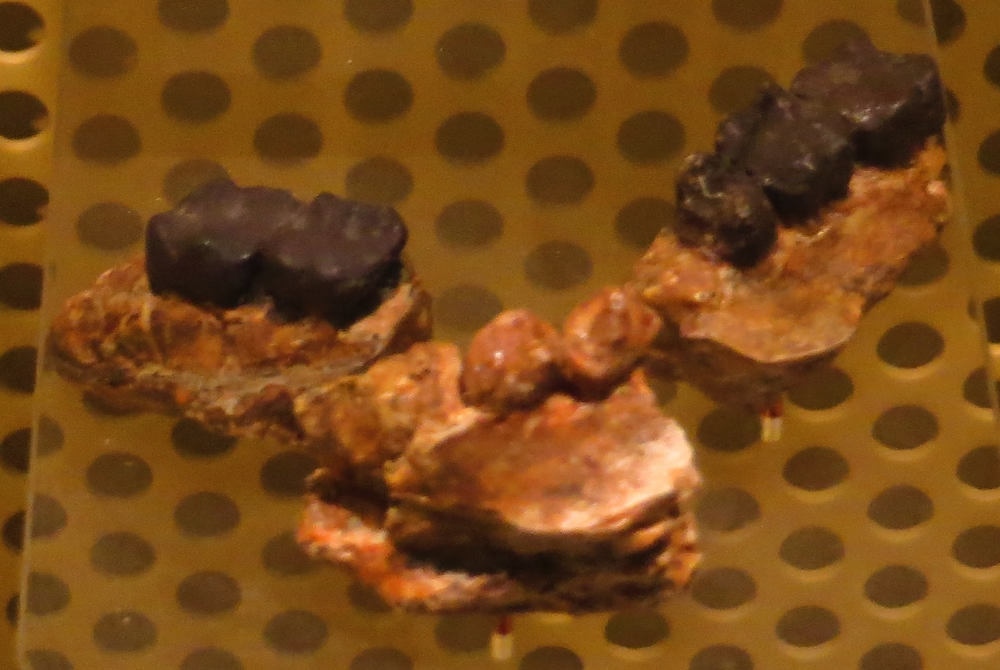
Photo: Ghedoghedo / Wikimedia Commons (opens in a new tab), CC BY-SA 4.0 (opens in a new tab). Resized and compressed.
THE HANDS BEHIND THE HISTORY
Remembering Heselon Mukiri.
Fossil discoveries begin with skilled people, not just famous names. Heselon Mukiri, a long-serving Kenyan member of the Leakeys’ research team, managed excavations at Fort Ternan while Louis Leakey was occupied at Olduvai.
The Leakey Foundation records Mukiri bringing Leakey two pieces of upper jaw and a lower molar. He also oversaw renewed work at the site in 1962, when more remains were recovered. His contribution belongs at the centre of the Fort Ternan story.
Source: The Leakey Foundation: Fossil Finders — Heselon Mukiri (opens in a new tab).
THEN, NOW & WHAT COMES NEXT
A story across time.
- ≈14m
The Miocene world
Kenyapithecus wickeri lives in a world far older than our own species.
- 1961
A landmark find
Fossil material recovered at Fort Ternan becomes the basis for a newly named ape species.
- 1962
A name enters science
Leakey describes Kenyapithecus wickeri; further excavations add to the evidence from the site.
- Today
Your turn to be curious
Visit the place behind the research and consider how fragments of the past can change the questions we ask.
Historical chronology: UNESCO’s human-origins research overview (opens in a new tab) and The Leakey Foundation (opens in a new tab). Fort Ternan is not presented here as a UNESCO World Heritage property.
More than one ancient ape.
Fort Ternan’s scientific interest extends beyond primates. Studies also describe rhinoceros fossils from the deposits. An assemblage of different animals helps researchers ask what an ancient environment was like, rather than treating a single fossil in isolation.
The green hills visible today are a starting point for imagination, not a photograph of the Miocene. Reconstructing an ancient landscape takes evidence, comparison and careful interpretation.
Research collection: Naturalis — Rhinocerotidae from Fort Ternan (opens in a new tab).
A FEW GOOD QUESTIONS
Stay curious.
How old is “14 million years”?
It means roughly 14,000,000 years. That is deep geological time: far earlier than recorded history, agriculture or the lives of modern humans.
Will I see the original discovery fossils?
Ask the museum team about the current displays before travelling. Published research and photographs of fossils do not confirm that the original specimens are exhibited at this local site.
Can I collect a fossil or a stone from the site?
Please leave material where it is and tell the museum team if you notice something interesting. A fossil’s position is part of its scientific story; moving it can lose valuable context.
Is this a good place for a school visit?
The story offers a starting point for learning about geology, evolution and Kenyan scientific heritage. Contact NMK’s education team to discuss access, group arrangements and the learning support available for your visit.